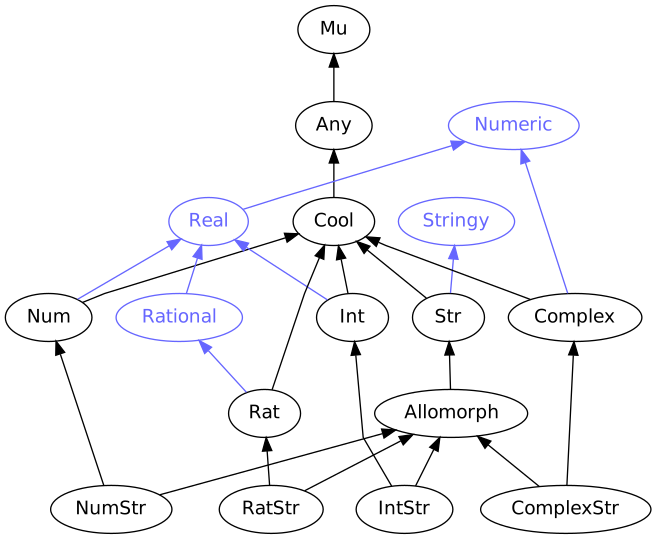
class Str is Cool does Stringy { }
Built-in class for strings. Objects of type Str are immutable.
Methods§
routine chop§
multi method chop(Str:D:)
multi method chop(Str:D: Int() $chopping)
Returns the string with $chopping characters removed from the end.
say "Whateverable".chop(3.6); # OUTPUT: «Whatevera» my $string= "Whateverable"; say $string.chop("3"); # OUTPUT: «Whatevera»
The $chopping positional is converted to Int before being applied to the string.
routine chomp§
multi        chomp(Str:D  --> Str:D)
multi method chomp(Str:D: --> Str:D)
Returns the string with a logical newline (any codepoint that has the NEWLINE property) removed from the end.
Examples:
say chomp("abc\n"); # OUTPUT: «abc» say "def\r\n".chomp; # OUTPUT: «def» NOTE: \r\n is a single grapheme! say "foo\r".chomp; # OUTPUT: «foo»
method contains§
multi method contains(Str:D: Cool:D $needle, :i(:$ignorecase), :m(:$ignoremark) --> Bool:D)
multi method contains(Str:D: Str:D $needle, :i(:$ignorecase), :m(:$ignoremark) --> Bool:D)
multi method contains(Str:D: Regex:D $needle --> Bool:D)
multi method contains(Str:D: Cool:D $needle, Int(Cool:D) $pos, :i(:$ignorecase), :m(:$ignoremark) --> Bool:D)
multi method contains(Str:D: Str:D $needle, Int:D $pos, :i(:$ignorecase), :m(:$ignoremark) --> Bool:D)
multi method contains(Str:D: Regex:D $needle, Int:D $pos --> Bool:D)
multi method contains(Str:D: Regex:D $needle, Cool:D $pos --> Bool:D)
Given a Str invocant (known as the haystack) and a first argument (known as the $needle), it searches for the $needle in the haystack from the beginning of the string and returns True if $needle is found. If the optional parameter $pos is provided, then contains will search the haystack starting from $pos characters into the string.
say "Hello, World".contains('Hello'); # OUTPUT: «True» say "Hello, World".contains('hello'); # OUTPUT: «False» say "Hello, World".contains('Hello', 1); # OUTPUT: «False» say "Hello, World".contains(','); # OUTPUT: «True» say "Hello, World".contains(',', 3); # OUTPUT: «True» say "Hello, World".contains(',', 10); # OUTPUT: «False»
In the first case, contains searches for the 'Hello' string on the invocant right from the start of the invocant string and returns True. In the third case, the 'Hello' string is not found since we have started looking from the second position (index 1) in 'Hello, World'.
Since Rakudo version 2020.02, the $needle can also be a Regex in which case the contains method quickly returns whether the regex matches the string at least once. No Match objects are created, so this is relatively fast.
say 'Hello, World'.contains(/\w <?before ','>/); # OUTPUT: «True» say 'Hello, World'.contains(/\w <?before ','>/, 5); # OUTPUT: «False»
Since Rakudo version 2020.02, if the optional named parameter :ignorecase, or :i, is specified, the search for $needle ignores the distinction between uppercase, lowercase, and titlecase letters.
say "Hello, World".contains("world"); # OUTPUT: «False» say "Hello, World".contains("world", :ignorecase); # OUTPUT: «True»
Since Rakudo version 2020.02, if the optional named parameter :ignoremark, or :m, is specified, the search for $needle only considers base characters, and ignores additional marks such as combining accents.
say "abc".contains("ä"); # OUTPUT: «False» say "abc".contains("ä", :ignoremark); # OUTPUT: «True»
Note that because of how a List or Array is coerced into a Str, the results may sometimes be surprising.
say <Hello, World>.contains('Hello'); # OUTPUT: «True» say <Hello, World>.contains('Hello', 0); # OUTPUT: «True» say <Hello, World>.contains('Hello', 1); # OUTPUT: «False»
See traps.
routine lc§
multi        lc(Str:D  --> Str:D)
multi method lc(Str:D: --> Str:D)
Returns a lowercase version of the string.
Examples:
lc("A"); # OUTPUT: «"a"»
"A".lc;  # OUTPUT: «"a"»
routine uc§
multi        uc(Str:D  --> Str:D)
multi method uc(Str:D: --> Str:D)
Returns an uppercase version of the string.
routine fc§
multi        fc(Str:D  --> Str:D)
multi method fc(Str:D: --> Str:D)
Does a Unicode "fold case" operation suitable for doing caseless string comparisons. (In general, the returned string is unlikely to be useful for any purpose other than comparison.)
routine tc§
multi        tc(Str:D  --> Str:D)
multi method tc(Str:D: --> Str:D)
Does a Unicode "titlecase" operation, that is changes the first character in the string to titlecase, or to uppercase if the character has no titlecase mapping.
routine tclc§
multi        tclc(Str:D  --> Str:D)
multi method tclc(Str:D: --> Str:D)
Turns the first character to titlecase, and all other characters to lowercase.
routine wordcase§
multi        wordcase(Cool $x  --> Str)
multi        wordcase(Str:D $x --> Str)
multi method wordcase(Str:D: :&filter = &tclc, Mu :$where = True --> Str)
Returns a string in which &filter has been applied to all the words that match $where. By default, this means that the first letter of every word is capitalized, and all the other letters lowercased.
method unival§
multi method unival(Str:D: --> Numeric)
Returns the numeric value that the first codepoint in the invocant represents, or NaN if it's not numeric.
say '4'.unival; # OUTPUT: «4» say '¾'.unival; # OUTPUT: «0.75» say 'a'.unival; # OUTPUT: «NaN»
method univals§
multi method univals(Str:D: --> List)
Returns a list of numeric values represented by each codepoint in the invocant string, and NaN for non-numeric characters.
say "4a¾".univals; # OUTPUT: «(4 NaN 0.75)»
routine chars§
multi        chars(Cool  $x --> Int:D)
multi        chars(Str:D $x --> Int:D)
multi        chars(str   $x --> int)
multi method chars(Str:D:   --> Int:D)
Returns the number of characters in the string in graphemes. On the JVM, this currently erroneously returns the number of codepoints instead.
method encode§
multi method encode(Str:D $encoding = 'utf8', :$replacement, Bool() :$translate-nl = False, :$strict)
Returns a Blob which represents the original string in the given encoding and normal form. The actual return type is as specific as possible, so $str.encode('UTF-8') returns a utf8 object, $str.encode('ISO-8859-1') a buf8. If :translate-nl is set to True, it will translate newlines from \n to \r\n, but only in Windows. $replacement indicates how characters are going to be replaced in the case they are not available in the current encoding, while $strict indicates whether unmapped codepoints will still decode; for instance, codepoint 129 which does not exist in windows-1252.
my $str = "Þor is mighty"; say $str.encode("ascii", :replacement( 'Th') ).decode("ascii"); # OUTPUT: «Thor is mighty»
In this case, any unknown character is going to be substituted by Th. We know in advance that the character that is not known in the ascii encoding is Þ, so we substitute it by its latin equivalent, Th. In the absence of any replacement set of characters, :replacement is understood as a Bool:
say $str.encode("ascii", :replacement).decode("ascii"); # OUTPUT: «?or is mighty»
If :replacement is not set or assigned a value, the error Error encoding ASCII string: could not encode codepoint 222 will be issued (in this case, since þ is codepoint 222).
Since the Blob returned by encode is the original string in normal form, and every element of a Blob is a byte, you can obtain the length in bytes of a string by calling a method that returns the size of the Blob on it:
say "þor".encode.bytes; # OUTPUT: «4» say "þor".encode.elems; # OUTPUT: «4»
method index§
multi method index(Str:D: Cool:D $needle, :i(:$ignorecase), :m(:$ignoremark) --> Int:D)
multi method index(Str:D: Str:D $needle, :i(:$ignorecase), :m(:$ignoremark) --> Int:D)
multi method index(Str:D: Cool:D $needle, Cool:D $pos, :i(:$ignorecase), :m(:$ignoremark) --> Int:D)
multi method index(Str:D: Str:D $needle, Int:D $pos, :i(:$ignorecase), :m(:$ignoremark) --> Int:D)
multi method index(Str:D: @needles --> Int:D)
multi method index(Str:D: @needles, :m(:$ignoremark)! --> Int:D)
multi method index(Str:D: @needles, :i(:$ignorecase)!, :m(:$ignoremark) --> Int:D)
Searches for $needle in the string starting from $pos (if present). It returns the offset into the string where $needle was found, and Nil if it was not found.
Since Rakudo version 2020.02, if the optional named parameter :ignorecase, or :i, is specified, the search for $needle ignores the distinction between uppercase, lowercase and titlecase letters. In addition, if the optional named parameter :ignoremark, or :m, is specified, the search for $needle only considers base characters, and ignores additional marks such as combining accents.
Since Rakudo version 2020.05, index accepts a list of needles to search the string with, and return the lowest index found or Nil.
Examples:
say "Camelia is a butterfly".index("a"); # OUTPUT: «1» say "Camelia is a butterfly".index("a", 2); # OUTPUT: «6» say "Camelia is a butterfly".index("er"); # OUTPUT: «17» say "Camelia is a butterfly".index("Camel"); # OUTPUT: «0» say "Camelia is a butterfly".index("Onion"); # OUTPUT: «Nil» say "Camelia is a butterfly".index(<a e i u>); # OUTPUT: «1» say "Camelia is a butterfly".index(<a c>, :i); # OUTPUT: «0» say "Camelia is a butterfly".index(('w', 'x')); # OUTPUT: «Nil» say "Hello, World".index("world"); # OUTPUT: «Nil» say "Hello, World".index("world", :ignorecase); # OUTPUT: «7» say "abc".index("ä"); # OUTPUT: «Nil» say "abc".index("ä", :ignoremark); # OUTPUT: «0» say "abc".index("x").defined ?? 'OK' !! 'NOT'; # OUTPUT: «NOT»
Other forms of index, including subs, are inherited from Cool.
routine rindex§
multi method rindex(Str:D: Str:D $needle --> Int:D)
multi method rindex(Str:D: Str:D $needle, Int:D $pos --> Int:D)
multi method rindex(Str:D: @needles --> Int:D)
Returns the last position of $needle in the string not after $pos. Returns Nil if $needle wasn't found.
Since Rakudo version 2020.05, rindex accepts a list of needles to search the string with, and return the highest index found or Nil.
Examples:
say "aardvark".rindex: "a"; # OUTPUT: «5» say "aardvark".rindex: "a", 0; # OUTPUT: «0 say "aardvark".rindex: "t"; # OUTPUT: «Nil» say "aardvark".rindex: <d v k>; # OUTPUT: «7»
Other forms of rindex, including subs, are inherited from Cool.
method indices§
multi method indices(Str:D: Str:D $needle, :i(:$ignorecase), :m(:$ignoremark), :$overlap --> List:D)
multi method indices(Str:D: Str:D $needle, Int:D $start, :i(:$ignorecase), :m(:$ignoremark), :$overlap --> List:D)
Searches for all occurrences of $needle in the string starting from position $start, or zero if it is not specified, and returns a List with all offsets in the string where $needle was found, or an empty list if it was not found.
If the optional parameter :overlap is specified the search continues from the index directly following the previous match, otherwise the search will continue after the previous match.
say "banana".indices("a"); # OUTPUT: «(1 3 5)» say "banana".indices("ana"); # OUTPUT: «(1)» say "banana".indices("ana", :overlap); # OUTPUT: «(1 3)» say "banana".indices("ana", 2); # OUTPUT: «(3)»
Since Rakudo version 2020.02, if the optional named parameter :ignorecase, or :i, is specified, the search for $needle ignores the distinction between uppercase, lowercase and titlecase letters.
say "banAna".indices("a"); # OUTPUT:«(1 5)» say "banAna".indices("a", :ignorecase); # OUTPUT:«(1 3 5)»
Since Rakudo 2020.02, if the optional named parameter :ignoremark, or :m, is specified, the search for $needle only considers base characters, and ignores additional marks such as combining accents.
say "tête-à-tête".indices("te"); # OUTPUT:«(2 9)» say "tête-à-tête".indices("te", :ignoremark); # OUTPUT:«(0 2 7 9)»
method match§
method match($pat, :continue(:$c), :pos(:$p), :global(:$g), :overlap(:$ov), :exhaustive(:$ex), :st(:$nd), :rd(:$th), :$nth, :$x --> Match)
Performs a match of the string against $pat and returns a Match object if there is a successful match; it returns (Any) otherwise. Matches are stored in the default match variable $/. If $pat is not a Regex object, match will coerce the argument to a Str and then perform a literal match against $pat.
A number of optional named parameters can be specified, which alter how the match is performed.
:continue
The :continue adverb takes as an argument the position where the regex should start to search. If no position is specified for :c it will default to 0 unless $/ is set, in which case it defaults to $/.to.
:pos
Takes a position as an argument. Fails if regex cannot be matched from that position, unlike :continue.
:global
Instead of searching for just one match and returning a Match object, search for every non-overlapping match and return them in a List.
:overlap
Finds all matches including overlapping matches, but only returns one match from each starting position.
:exhaustive
Finds all possible matches of a regex, including overlapping matches and matches that start at the same position.
:st, :nd, :rd, :nth
Returns the nth match in the string. The argument can be a Numeric or an Iterable producing monotonically increasing numbers (that is, the next produced number must be larger than the previous one). The Iterable will be lazily reified and if non-monotonic sequence is encountered an exception will be thrown.
If Iterable argument is provided the return value and $/ variable will be set to a possibly-empty List of Match objects.
:x
Takes as an argument the number of matches to return, stopping once the specified number of matches has been reached. The value must be a Numeric or a Range; other values will cause .match to return a Failure containing an X::Str::Match::x exception.
Examples:
say "properly".match('perl'); # OUTPUT: «「perl」» say "properly".match(/p.../); # OUTPUT: «「prop」» say "1 2 3".match([1,2,3]); # OUTPUT: «「1 2 3」» say "a1xa2".match(/a./, :continue(2)); # OUTPUT: «「a2」» say "abracadabra".match(/ a .* a /, :exhaustive); # OUTPUT: «(「abracadabra」 「abracada」 「abraca」 「abra」 「acadabra」 「acada」 「aca」 「adabra」 「ada」 「abra」)» say 'several words here'.match(/\w+/,:global); # OUTPUT: «(「several」 「words」 「here」)» say 'abcdef'.match(/.*/, :pos(2)); # OUTPUT: «「cdef」» say "foo[bar][baz]".match(/../, :1st); # OUTPUT: «「fo」» say "foo[bar][baz]".match(/../, :2nd); # OUTPUT: «「o[」» say "foo[bar][baz]".match(/../, :3rd); # OUTPUT: «「ba」» say "foo[bar][baz]".match(/../, :4th); # OUTPUT: «「r]」» say "foo[bar][baz]bada".match('ba', :x(2)); # OUTPUT: «(「ba」 「ba」)»
method Numeric§
method Numeric(Str:D: --> Numeric:D)
Coerces the string to Numeric using semantics equivalent to val routine. Fails with X::Str::Numeric if the coercion to a number cannot be done.
Only Unicode characters with property Nd, as well as leading and trailing whitespace are allowed, with the special case of the empty string being coerced to 0. Synthetic codepoints (e.g. "7\x[308]") are forbidden.
While Nl and No characters can be used as numeric literals in the language, their conversion via Str.Numeric will fail, by design; the same will happen with synthetic numerics (composed of numbers and diacritic marks). See unival if you need to coerce such characters to Numeric. +, - and the Unicode MINUS SIGN − are all allowed.
" −33".Numeric; # OUTPUT: «-33»
method Num§
method Num(Str:D: --> Num:D)
Coerces the string to Num, using the same rules as Str.Numeric and handling negative zero, -0e0, and positive zero, 0e0.
my Str $s = "-0/5"; say (.self, .^name) given $s.Numeric; # OUTPUT: «(0 Rat)» say (.self, .^name) given $s.Num; # OUTPUT: «(-0 Num)»
method Int§
method Int(Str:D: --> Int:D)
Coerces the string to Int, using the same rules as Str.Numeric.
method Rat§
method Rat(Str:D: --> Rational:D)
Coerces the string to a Rat object, using the same rules as Str.Numeric. If the denominator is larger than 64-bits is it still kept and no degradation to Num occurs.
method Bool§
method Bool(Str:D: --> Bool:D)
Returns False if the string is empty, True otherwise.
routine parse-base§
multi        parse-base(Str:D $num, Int:D $radix --> Numeric)
multi method parse-base(Str:D $num: Int:D $radix --> Numeric)
Performs the reverse of base by converting a string with a base-$radix number to its Numeric equivalent. Will fail if radix is not in range 2..36 or if the string being parsed contains characters that are not valid for the specified base.
1337.base(32).parse-base(32).say; # OUTPUT: «1337» 'Raku'.parse-base(36).say; # OUTPUT: «1273422» 'FF.DD'.parse-base(16).say; # OUTPUT: «255.863281»
See also: syntax for number literals
routine parse-names§
sub    parse-names(Str:D $names  --> Str:D)
method parse-names(Str:D $names: --> Str:D)
DEPRECATED. Use uniparse instead. Existed in Rakudo implementation as a proof of viability implementation before being renamed and will be removed when 6.e language is released.
routine uniparse§
sub    uniparse(Str:D $names  --> Str:D)
method uniparse(Str:D $names: --> Str:D)
Takes string with comma-separated Unicode names of characters and returns a string composed of those characters. Will fail if any of the characters' names are empty or not recognized. Whitespace around character names is ignored.
say "I {uniparse 'TWO HEARTS'} Raku"; # OUTPUT: «I 💕 Raku» 'TWO HEARTS, BUTTERFLY'.uniparse.say; # OUTPUT: «💕🦋»
See uniname and uninames for routines that work in the opposite direction with a single codepoint and multiple codepoints respectively.
Note that unlike \c[...] construct available in string interpolation, uniparse does not accept decimal numerical values. Use chr routine to convert those:
say "\c[1337]"; # OUTPUT: «Թ» say '1337'.chr; # OUTPUT: «Թ»
Note: before being standardized in 2017.12, this routine was known under its working name of parse-names. This denomination will be removed in the 6.e version.
method samecase§
multi method samecase(Str:D: Str:D $pattern --> Str:D)
Returns a copy of the invocant with case information for each individual character changed according to $pattern.
Note: The pattern string can contain three types of characters, i.e. uppercase, lowercase and caseless. For a given character in $pattern its case information determines the case of the corresponding character in the result.
If the invocant is longer than $pattern, the case information from the last character of $pattern is applied to the remaining characters of the invocant.
say "raKu".samecase("A_a_"); # OUTPUT: «Raku» say "rAKU".samecase("Ab"); # OUTPUT: «Raku»
routine split§
multi        split(  Str:D $delimiter, Str:D $input, $limit = Inf,
  :$skip-empty, :$v, :$k, :$kv, :$p)
multi        split(Regex:D $delimiter, Str:D $input, $limit = Inf,
  :$skip-empty, :$v, :$k, :$kv, :$p)
multi        split(List:D $delimiters, Str:D $input, $limit = Inf,
  :$skip-empty, :$v, :$k, :$kv, :$p)
multi method split(Str:D:   Str:D $delimiter, $limit = Inf,
  :$skip-empty, :$v, :$k, :$kv, :$p)
multi method split(Str:D: Regex:D $delimiter, $limit = Inf,
  :$skip-empty, :$v, :$k, :$kv, :$p)
multi method split(Str:D: List:D $delimiters, $limit = Inf,
  :$skip-empty, :$v, :$k, :$kv, :$p)
Splits a string up into pieces based on delimiters found in the string.
If DELIMITER is a string, it is searched for literally and not treated as a regex. If DELIMITER is the empty string, it effectively returns all characters of the string separately (plus an empty string at the begin and at the end). If PATTERN is a regular expression, then that will be used to split up the string. If DELIMITERS is a list, then all of its elements will be considered a delimiter (either a string or a regular expression) to split the string on.
The optional LIMIT indicates in how many segments the string should be split, if possible. It defaults to Inf (or *, whichever way you look at it), which means "as many as possible". Note that specifying negative limits will not produce any meaningful results.
A number of optional named parameters can be specified, which alter the result being returned. The :v, :k, :kv and :p named parameters all perform a special action with regards to the delimiter found.
:skip-empty
If specified, do not return empty strings before or after a delimiter.
:v
Also return the delimiter. If the delimiter was a regular expression, then this will be the associated Match object. Since this stringifies as the delimiter string found, you can always assume it is the delimiter string if you're not interested in further information about that particular match.
:k
Also return the index of the delimiter. Only makes sense if a list of delimiters was specified: in all other cases, this will be 0.
:kv
Also return both the index of the delimiter, as well as the delimiter.
:p
Also return the index of the delimiter and the delimiter as a Pair.
Examples:
say split(";", "a;b;c").raku; # OUTPUT: «("a", "b", "c").Seq» say split(";", "a;b;c", :v).raku; # OUTPUT: «("a", ";", "b", ";", "c").Seq» say split(";", "a;b;c", 2).raku; # OUTPUT: «("a", "b;c").Seq» say split(";", "a;b;c", 2, :v).raku; # OUTPUT: «("a", ";", "b;c").Seq» say split(";", "a;b;c,d").raku; # OUTPUT: «("a", "b", "c,d").Seq» say split(/\;/, "a;b;c,d").raku; # OUTPUT: «("a", "b", "c,d").Seq» say split(<; ,>, "a;b;c,d").raku; # OUTPUT: «("a", "b", "c", "d").Seq» say split(/<[;,]>/, "a;b;c,d").raku; # OUTPUT: «("a", "b", "c", "d").Seq» say split(<; ,>, "a;b;c,d", :k).raku; # OUTPUT: «("a", 0, "b", 0, "c", 1, "d").Seq» say split(<; ,>, "a;b;c,d", :kv).raku; # OUTPUT: «("a", 0, ";", "b", 0, ";", "c", 1, ",", "d").Seq» say "".split("x").raku; # OUTPUT: «("",).Seq» say "".split("x", :skip-empty).raku; # OUTPUT: «().Seq» say "abcde".split("").raku; # OUTPUT: «("", "a", "b", "c", "d", "e", "").Seq» say "abcde".split("",:skip-empty).raku; # OUTPUT: «("a", "b", "c", "d", "e").Seq»
routine comb§
multi        comb(Str:D   $matcher, Str:D $input, $limit = Inf)
multi        comb(Regex:D $matcher, Str:D $input, $limit = Inf, Bool :$match)
multi        comb(Int:D $size, Str:D $input, $limit = Inf)
multi method comb(Str:D $input:)
multi method comb(Str:D $input: Str:D   $matcher, $limit = Inf)
multi method comb(Str:D $input: Regex:D $matcher, $limit = Inf, Bool :$match)
multi method comb(Str:D $input: Int:D $size, $limit = Inf)
Searches for $matcher in $input and returns a Seq of non-overlapping matches limited to at most $limit matches.
If $matcher is a Regex, each Match object is converted to a Str, unless $match is set (available as of the 2020.01 release of the Rakudo compiler).
If no matcher is supplied, a Seq of characters in the string is returned, as if the matcher was rx/./.
Examples:
say "abc".comb.raku; # OUTPUT: «("a", "b", "c").Seq» say "abc".comb(:match).raku; # OUTPUT: «(「a」 「b」 「c」)» say 'abcdefghijk'.comb(3).raku; # OUTPUT: «("abc", "def", "ghi", "jk").Seq» say 'abcdefghijk'.comb(3, 2).raku; # OUTPUT: «("abc", "def").Seq» say comb(/\w/, "a;b;c").raku; # OUTPUT: «("a", "b", "c").Seq» say comb(/\N/, "a;b;c").raku; # OUTPUT: «("a", ";", "b", ";", "c").Seq» say comb(/\w/, "a;b;c", 2).raku; # OUTPUT: «("a", "b").Seq» say comb(/\w\;\w/, "a;b;c", 2).raku; # OUTPUT: «("a;b",).Seq» say comb(/.<(.)>/, "<>[]()").raku; # OUTPUT: «(">", "]", ")").Seq»
If the matcher is an integer value, comb behaves as if the matcher was rx/ . ** {1..$matcher} /, but which is optimized to be much faster.
Note that a Regex matcher may control which portion of the matched text is returned by using features which explicitly set the top-level capture.
multi        comb(Pair:D $rotor, Str:D $input, $limit = Inf, Bool :$partial)
multi method comb(Str:D $input: Pair:D $rotor, $limit = Inf, Bool :$partial)
Available as of 6.e language version (early implementation exists in Rakudo compiler 2022.12+). The rotor pair indicates the number of characters to fetch as the key (the "size"), and the number of "steps" forward to take afterwards. Its main intended use is to provide a way to create N-grams from strings in an efficient manner. By default only strings of the specified size will be produced. This can be overridden by specifying the named argument :partial with a true value.
Examples:
say "abcde".comb(3 => -2); # OUTPUT: «(abc bcd cde)» say "abcde".comb(3 => -2, :partial); # OUTPUT: «(abc bcd cde de e)» say "abcdefg".comb(3 => -2, 2); # OUTPUT: «(abc bcd)» say comb(3 => -2, "abcde"); # OUTPUT: «(abc bcd cde)» say comb(5 => -2, "abcde", :partial); # OUTPUT: «(abc bcd cde de e)» say comb(5 => -2, "abcdefg", 2); # OUTPUT: «(abc bcd)»
routine lines§
multi method lines(Str:D: $limit, :$chomp = True)
multi method lines(Str:D: :$chomp = True)
Returns a list of lines. By default, it chomps line endings the same as a call to $input.comb( / ^^ \N* /, $limit ) would. To keep line endings, set the optional named parameter $chomp to False.
Examples:
say lines("a\nb").raku; # OUTPUT: «("a", "b").Seq» say lines("a\nb").elems; # OUTPUT: «2» say "a\nb".lines.elems; # OUTPUT: «2» say "a\n".lines.elems; # OUTPUT: «1» # Keep line endings say lines(:!chomp, "a\nb").raku; # OUTPUT: «("a\n", "b").Seq» say "a\n".lines(:!chomp).elems; # OUTPUT: «1»
You can limit the number of lines returned by setting the $limit variable to a non-zero, non-Infinity value:
say <not there yet>.join("\n").lines( 2 ); # OUTPUT: «(not there)»
DEPRECATED as of 6.d language, the :count argument was used to return the total number of lines:
say <not there yet>.join("\n").lines( :count ); # OUTPUT: «3»
Use elems call on the returned Seq instead:
say <not there yet>.join("\n").lines.elems; # OUTPUT: «3»
routine words§
multi method words(Str:D: $limit)
multi method words(Str:D:)
Returns a list of non-whitespace bits, i.e. the same as a call to $input.comb( / \S+ /, $limit ) would.
Examples:
say "a\nb\n".words.raku; # OUTPUT: «("a", "b").Seq» say "hello world".words.raku; # OUTPUT: «("hello", "world").Seq» say "foo:bar".words.raku; # OUTPUT: «("foo:bar",).Seq» say "foo:bar\tbaz".words.raku; # OUTPUT: «("foo:bar", "baz").Seq»
It can also be used as a subroutine, turning the first argument into the invocant. $limit is optional, but if it is provided (and not equal to Inf), it will return only the first $limit words.
say words("I will be very brief here", 2); # OUTPUT: «(I will)»
routine flip§
multi        flip(Str:D  --> Str:D)
multi method flip(Str:D: --> Str:D)
Returns the string reversed character by character.
Examples:
"Raku".flip;  # OUTPUT: «ukaR»
"ABBA".flip;  # OUTPUT: «ABBA»
method starts-with§
multi method starts-with(Str:D: Str(Cool) $needle, :i(:$ignorecase), :m(:$ignoremark) --> Bool:D)
Returns True if the invocant is identical to or starts with $needle.
say "Hello, World".starts-with("Hello"); # OUTPUT: «True» say "https://raku.org/".starts-with('ftp'); # OUTPUT: «False»
Since Rakudo version 2020.02, if the optional named parameter :ignorecase, or :i, is specified, the comparison of the invocant and $needle ignores the distinction between uppercase, lowercase and titlecase letters.
say "Hello, World".starts-with("hello"); # OUTPUT: «False» say "Hello, World".starts-with("hello", :ignorecase); # OUTPUT: «True»
Since Rakudo 2020.02, if the optional named parameter :ignoremark, or :m, is specified, the comparison of the invocant and $needle only considers base characters, and ignores additional marks such as combining accents.
say "abc".starts-with("ä"); # OUTPUT: «False» say "abc".starts-with("ä", :ignoremark); # OUTPUT: «True»
method ends-with§
multi method ends-with(Str:D: Str(Cool) $needle, :i(:$ignorecase), :m(:$ignoremark) --> Bool:D)
Returns True if the invocant is identical to or ends with $needle.
say "Hello, World".ends-with('Hello'); # OUTPUT: «False» say "Hello, World".ends-with('ld'); # OUTPUT: «True»
Since Rakudo version 2020.02, if the optional named parameter :ignorecase, or :i, is specified, the comparison of the invocant and $needle ignores the distinction between uppercase, lowercase and titlecase letters.
say "Hello, World".ends-with("world"); # OUTPUT: «False» say "Hello, World".ends-with("world", :ignorecase); # OUTPUT: «True»
Since Rakudo 2020.02, if the optional named parameter :ignoremark, or :m, is specified, the comparison of the invocant and $needle only considers base characters, and ignores additional marks such as combining accents.
say "abc".ends-with("ç"); # OUTPUT: «False» say "abc".ends-with("ç", :ignoremark); # OUTPUT: «True»
method subst§
multi method subst(Str:D: $matcher, $replacement = "", *%options)
Returns the invocant string where $matcher is replaced by $replacement (or the original string, if no match was found). If no $replacement is provided, the empty string is used (i.e., matched string(s) are removed).
There is an in-place syntactic variant of subst spelled s/matcher/replacement/ and with adverb following the s or inside the matcher.
$matcher can be a Regex, or a literal Str. Non-Str matcher arguments of type Cool are coerced to Str for literal matching. If a Regex $matcher is used, the $/ special variable will be set to Nil (if no matches occurred), a Match object, or a List of Match objects (if multi-match options like :g are used).
Literal replacement substitution§
my $some-string = "Some foo"; my $another-string = $some-string.subst(/foo/, "string"); # gives 'Some string' $some-string.=subst(/foo/, "string"); # in-place substitution. $some-string is now 'Some string' say "multi-hyphenate".subst("-"); # OUTPUT: «multihyphenate»
Callable§
The replacement can be a Callable in which the current Match object will be placed in the $/ variable, as well as the $_ topic variable. Using a Callable as replacement is how you can refer to any of the captures created in the regex:
# Using capture from $/ variable (the $0 is the first positional capture) say 'abc123defg'.subst(/(\d+)/, { " before $0 after " }); # OUTPUT: «abc before 123 after defg» # Using capture from $/ variable (the $<foo> is a named capture) say 'abc123defg'.subst(/$<foo>=\d+/, { " before $<foo> after " }); # OUTPUT: «abc before 123 after defg» # Using WhateverCode to operate on the Match given in $_: say 'abc123defg'.subst(/(\d+)/, "[ " ~ *.flip ~ " ]"); # OUTPUT: «abc[ 321 ]defg» # Using a Callable to generate substitution without involving current Match: my $i = 41; my $str = "The answer is secret."; say $str.subst(/secret/, {++$i}); # The answer to everything # OUTPUT: «The answer is 42.»
Adverbs§
The following adverbs are supported
| short | long | meaning |
|---|---|---|
| :g | :global | tries to match as often as possible |
| :nth(Int|Callable|Whatever) | only substitute the nth match; aliases: :st, :nd, :rd, and :th | |
| :ss | :samespace | preserves whitespace on substitution |
| :ii | :samecase | preserves case on substitution |
| :mm | :samemark | preserves character marks (e.g. 'ü' replaced with 'o' will result in 'ö') |
| :x(Int|Range|Whatever) | substitute exactly $x matches |
Note that only in the s/// form :ii implies :i and :ss implies :s. In the method form, the :s and :i modifiers must be added to the regex, not the subst method call.
More Examples§
Here are other examples of usage:
my $str = "Hey foo foo foo"; say $str.subst(/foo/, "bar", :g); # OUTPUT: «Hey bar bar bar» say $str.subst(/\s+/, :g); # OUTPUT: «Heyfoofoofoo» say $str.subst(/foo/, "bar", :x(0)); # OUTPUT: «Hey foo foo foo» say $str.subst(/foo/, "bar", :x(1)); # OUTPUT: «Hey bar foo foo» # Can not match 4 times, so no substitutions made say $str.subst(/foo/, "bar", :x(4)); # OUTPUT: «Hey foo foo foo» say $str.subst(/foo/, "bar", :x(2..4)); # OUTPUT: «Hey bar bar bar» # Replace all of them, identical to :g say $str.subst(/foo/, "bar", :x(*)); # OUTPUT: «Hey bar bar bar» say $str.subst(/foo/, "bar", :nth(3)); # OUTPUT: «Hey foo foo bar» # Replace last match say $str.subst(/foo/, "bar", :nth(*)); # OUTPUT: «Hey foo foo bar» # Replace next-to-last last match say $str.subst(/foo/, "bar", :nth(*-1)); # OUTPUT: «Hey foo bar foo»
The :nth adverb has readable English-looking variants:
say 'ooooo'.subst: 'o', 'x', :1st; # OUTPUT: «xoooo» say 'ooooo'.subst: 'o', 'x', :2nd; # OUTPUT: «oxooo» say 'ooooo'.subst: 'o', 'x', :3rd; # OUTPUT: «ooxoo» say 'ooooo'.subst: 'o', 'x', :4th; # OUTPUT: «oooxo»
method subst-mutate§
NOTE: .subst-mutate is deprecated in the 6.d version, and will be removed in future ones. You can use subst with .= method call assignment operator or s/// substitution operator instead.
Where subst returns the modified string and leaves the original unchanged, it is possible to mutate the original string by using subst-mutate. If the match is successful, the method returns a Match object representing the successful match, otherwise returns Nil. If :nth (or one of its aliases) with Iterable value, :g, :global, or :x arguments are used, returns a List of Match objects, or an empty List if no matches occurred.
my $some-string = "Some foo"; my $match = $some-string.subst-mutate(/foo/, "string"); say $some-string; # OUTPUT: «Some string» say $match; # OUTPUT: «「foo」» $some-string.subst-mutate(/<[oe]>/, '', :g); # remove every o and e, notice the :g named argument from .subst
If a Regex $matcher is used, the $/ special variable will be set to Nil (if no matches occurred), a Match object, or a List of Match objects (if multi-match options like :g are used).
routine substr§
multi        substr(Str:D $s, $from, $chars?  --> Str:D)
multi        substr(Str:D $s, Range  $from-to --> Str:D)
multi method substr(Str:D $s: $from, $chars?  --> Str:D)
multi method substr(Str:D $s: Range $from-to  --> Str:D)
Returns a substring of the original string, between the indices specified by $from-to's endpoints (coerced to Int) or from index $from and of length $chars.
Both $from and $chars can be specified as Callable, which will be invoked with the length of the original string and the returned value will be used as the value for the argument. If $from or $chars are not Callable, they'll be coerced to Int.
If $chars is omitted or is larger than the available characters, the string from $from until the end of the string is returned. If $from-to's starting index or $from is less than zero, X::OutOfRange exception is thrown. The $from-to's ending index is permitted to extend past the end of string, in which case it will be equivalent to the index of the last character.
say substr("Long string", 3..6); # OUTPUT: «g st» say substr("Long string", 6, 3); # OUTPUT: «tri» say substr("Long string", 6); # OUTPUT: «tring» say substr("Long string", 6, *-1); # OUTPUT: «trin» say substr("Long string", *-3, *-1); # OUTPUT: «in»
method substr-eq§
multi method substr-eq(Str:D:  Str(Cool) $test-string, Int(Cool) $from, :i(:$ignorecase), :m(:$ignoremark) --> Bool)
multi method substr-eq(Cool:D: Str(Cool) $test-string, Int(Cool) $from, :i(:$ignorecase), :m(:$ignoremark) --> Bool)
Returns True if the $test-string exactly matches the String object, starting from the given initial index $from. For example, beginning with the string "foobar", the substring "bar" will match from index 3:
my $string = "foobar"; say $string.substr-eq("bar", 3); # OUTPUT: «True»
However, the substring "barz" starting from index 3 won't match even though the first three letters of the substring do match:
my $string = "foobar"; say $string.substr-eq("barz", 3); # OUTPUT: «False»
Naturally, to match the entire string, one merely matches from index 0:
my $string = "foobar"; say $string.substr-eq("foobar", 0); # OUTPUT: «True»
Since Rakudo version 2020.02, if the optional named parameter :ignorecase, or :i, is specified, the comparison of the invocant and $test-string ignores the distinction between uppercase, lowercase and titlecase letters.
say "foobar".substr-eq("Bar", 3); # OUTPUT: «False» say "foobar".substr-eq("Bar", 3, :ignorecase); # OUTPUT: «True»
Since Rakudo version 2020.02, if the optional named parameter :ignoremark, or :m, is specified, the comparison of the invocant and $test-string only considers base characters, and ignores additional marks such as combining accents.
say "cliché".substr-eq("che", 3); # OUTPUT: «False» say "cliché".substr-eq("che", 3, :ignoremark); # OUTPUT: «True»
Since this method is inherited from the Cool type, it also works on integers. Thus the integer 42 will match the value 342 starting from index 1:
my $integer = 342; say $integer.substr-eq(42, 1); # OUTPUT: «True»
As expected, one can match the entire value by starting at index 0:
my $integer = 342; say $integer.substr-eq(342, 0); # OUTPUT: «True»
Also using a different value or an incorrect starting index won't match:
my $integer = 342; say $integer.substr-eq(42, 3); # OUTPUT: «False» say $integer.substr-eq(7342, 0); # OUTPUT: «False»
method substr-rw§
method substr-rw($from, $length = *)
A version of substr that returns a Proxy functioning as a writable reference to a part of a string variable. Its first argument, $from specifies the index in the string from which a substitution should occur, and its last argument, $length specifies how many characters are to be replaced. If not specified, $length defaults to the length of the string.
For example, in its method form, if one wants to take the string "abc" and replace the second character (at index 1) with the letter "z", then one does this:
my $string = "abc"; $string.substr-rw(1, 1) = "z"; $string.say; # OUTPUT: «azc»
Note that new characters can be inserted as well:
my $string = 'azc'; $string.substr-rw(2, 0) = "-Zorro-"; # insert new characters BEFORE the character at index 2 $string.say; # OUTPUT: «az-Zorro-c»
substr-rw also has a function form, so the above examples can also be written like so:
my $string = "abc"; substr-rw($string, 1, 1) = "z"; $string.say; # OUTPUT: «azc» substr-rw($string, 2, 0) = "-Zorro-"; $string.say; # OUTPUT: «az-Zorro-c»
It is also possible to alias the writable reference returned by substr-rw for repeated operations:
my $string = "A character in the 'Flintstones' is: barney"; $string ~~ /(barney)/; my $ref := substr-rw($string, $0.from, $0.to-$0.from); $string.say; # OUTPUT: «A character in the 'Flintstones' is: barney» $ref = "fred"; $string.say; # OUTPUT: «A character in the 'Flintstones' is: fred» $ref = "wilma"; $string.say; # OUTPUT: «A character in the 'Flintstones' is: wilma»
routine samemark§
multi  samemark(Str:D $string, Str:D $pattern --> Str:D)
method samemark(Str:D: Str:D $pattern --> Str:D)
Returns a copy of $string with the mark/accent information for each character changed such that it matches the mark/accent of the corresponding character in $pattern. If $string is longer than $pattern, the remaining characters in $string receive the same mark/accent as the last character in $pattern. If $pattern is empty no changes will be made.
Examples:
say 'åäö'.samemark('aäo'); # OUTPUT: «aäo» say 'åäö'.samemark('a'); # OUTPUT: «aao» say samemark('Räku', 'a'); # OUTPUT: «Raku» say samemark('aöä', ''); # OUTPUT: «aöä»
method succ§
method succ(Str:D: --> Str:D)
Returns the string incremented by one.
String increment is "magical". It searches for the last alphanumeric sequence that is not preceded by a dot, and increments it.
'12.34'.succ;      # OUTPUT: «13.34»
'img001.png'.succ; # OUTPUT: «img002.png»
The actual increment step works by mapping the last alphanumeric character to a character range it belongs to, and choosing the next character in that range, carrying to the previous letter on overflow.
'aa'.succ;   # OUTPUT: «ab»
'az'.succ;   # OUTPUT: «ba»
'109'.succ;  # OUTPUT: «110»
'α'.succ;    # OUTPUT: «β»
'a9'.succ;   # OUTPUT: «b0»
String increment is Unicode-aware, and generally works for scripts where a character can be uniquely classified as belonging to one range of characters.
method pred§
method pred(Str:D: --> Str:D)
Returns the string decremented by one.
String decrementing is "magical" just like string increment (see succ). It fails on underflow
'b0'.pred;           # OUTPUT: «a9»
'a0'.pred;           # OUTPUT: Failure
'img002.png'.pred;   # OUTPUT: «img001.png»
routine ord§
multi        ord(Str:D  --> Int:D)
multi method ord(Str:D: --> Int:D)
Returns the codepoint number of the base characters of the first grapheme in the string.
Example:
ord("A"); # 65
"«".ord;  # 171
method ords§
multi method ords(Str:D: --> Seq)
Returns a list of Unicode codepoint numbers that describe the codepoints making up the string.
Example:
"aå«".ords; # (97 229 171)
Strings are represented as graphemes. If a character in the string is represented by multiple codepoints, then all of those codepoints will appear in the result of ords. Therefore, the number of elements in the result may not always be equal to chars, but will be equal to codes; codes computes the codepoints in a different way, so the result might be faster.
The codepoints returned will represent the string in NFC. See the NFD, NFKC, and NFKD methods if other forms are required.
method trans§
multi method trans(Str:D: Pair:D \what, *%n --> Str)
multi method trans(Str:D: *@changes, :complement(:$c), :squash(:$s), :delete(:$d) --> Str)
Replaces one or many characters with one or many characters. Ranges are supported, both for keys and values. Regexes work as keys. In case a list of keys and values is used, substrings can be replaced as well. When called with :complement anything but the matched value or range is replaced with a single value; with :delete the matched characters without corresponding replacement are removed. Combining :complement and :delete will remove anything but the matched values, unless replacement characters have been specified, in which case, :delete would be ignored. The adverb :squash will reduce repeated matched characters to a single character.
Example:
my $str = 'say $x<b> && $y<a>'; $str.=trans( '<' => '«' ); $str.=trans( '<' => '«', '>' => '»' ); $str.=trans( [ '<' , '>' , '&' ] => [ '<', '>', '&' ]); $str.=trans( ['a'..'y'] => ['A'..'z'] ); "abcdefghij".trans(/<[aeiou]> \w/ => ''); # OUTPUT: «cdgh» "a123b123c".trans(['a'..'z'] => 'x', :complement); # OUTPUT: «axxxbxxxc» "aaa1123bb123c".trans('a'..'z' => 'A'..'Z', :squash); # OUTPUT: «A1123B123C» "aaa1123bb123c".trans('a'..'z' => 'x', :complement, :squash); # OUTPUT: «aaaxbbxc»
In general, the strings will have the same length after the substitution:
say "a123b123c".trans('23' => '4'); # OUTPUT: «a144b144c» say "a123b123c".trans('123' => 'þð'); # OUTPUT: «aþðþbþðþc»
:squash and :delete will have the same effect in this case making it a strict substitution:
say "a123b123c".trans('123' => 'þð', :squash); # OUTPUT: «aþðbþðc» say "a123b123c".trans('123' => 'þð', :delete); # OUTPUT: «aþðbþðc»
:delete will also remove non-matched characters from the original string:
say "abc".trans("abc".comb => 1..2, :delete); # OUTPUT: «12»
Please note that the behavior of the two versions of the multi method is slightly different. The first form will transpose only one character if the origin is also one character:
say "abcd".trans( "a" => "zz" ); # OUTPUT: «zbcd» say "abcd".trans( "ba" => "yz" ); # OUTPUT: «zycd»
In the second case, behavior is as expected, since the origin is more than one char long. However, if the Pair in the multi method does not have a Str as an origin or target, it is handled to the second multi method, and behavior changes:
say "abcd".trans: ["a"] => ["zz"]; # OUTPUT: «zzbcd»
In this case, neither origin nor target in the Pair are Str; the method with the Pair signature then calls the second, making this call above equivalent to "abcd".trans: ["a"] => ["zz"], (with the comma behind, making it a Positional, instead of a Pair), resulting in the behavior shown as output.
method indent§
multi method indent(Int $steps where { $_ == 0 } )
multi method indent(Int $steps where { $_ > 0  } )
multi method indent($steps where { .isa(Whatever) || .isa(Int) && $_ < 0 } )
Indents each line of the string by $steps. If $steps is negative, it outdents instead. If $steps is *, then the string is outdented to the margin:
"  indented by 2 spaces\n    indented even more".indent(*)
    eq "indented by 2 spaces\n  indented even more"
method trim§
method trim(Str:D: --> Str)
Remove leading and trailing whitespace. It can be used both as a method on strings and as a function. When used as a method it will return the trimmed string. In order to do in-place trimming, one needs to write .=trim
my $line = ' hello world '; say '<' ~ $line.trim ~ '>'; # OUTPUT: «<hello world>» say '<' ~ trim($line) ~ '>'; # OUTPUT: «<hello world>» $line.trim; say '<' ~ $line ~ '>'; # OUTPUT: «< hello world >» $line.=trim; say '<' ~ $line ~ '>'; # OUTPUT: «<hello world>»
See also trim-trailing and trim-leading.
method trim-trailing§
method trim-trailing(Str:D: --> Str)
Removes the whitespace characters from the end of a string. See also trim.
method trim-leading§
method trim-leading(Str:D: --> Str)
Removes the whitespace characters from the beginning of a string. See also trim.
method NFC§
method NFC(Str:D: --> NFC:D)
Returns a codepoint string in NFC format (Unicode Normalization Form C / Composed).
method NFD§
method NFD(Str:D: --> NFD:D)
Returns a codepoint string in NFD format (Unicode Normalization Form D / Decomposed).
method NFKC§
method NFKC(Str:D: --> NFKC:D)
Returns a codepoint string in NFKC format (Unicode Normalization Form KC / Compatibility Composed).
method NFKD§
method NFKD(Str:D: --> NFKD:D)
Returns a codepoint string in NFKD format (Unicode Normalization Form KD / Compatibility Decomposed).
method ACCEPTS§
multi method ACCEPTS(Str:D: $other)
Returns True if the string is the same as $other.
method Capture§
method Capture()
Throws X::Cannot::Capture.
routine val§
multi val(*@maybevals)
multi val(Slip:D \maybevals)
multi val(List:D \maybevals)
multi val(Pair:D \ww-thing)
multi val(\one-thing)
multi val(Str:D $MAYBEVAL, :$val-or-fail)
Given a Str that may be parsable as a numeric value, it will attempt to construct the appropriate allomorph, returning one of IntStr, NumStr, RatStr or ComplexStr or a plain Str if a numeric value cannot be parsed.
say val("42").^name; # OUTPUT: «IntStr» say val("42e0").^name; # OUTPUT: «NumStr» say val("42.0").^name; # OUTPUT: «RatStr» say val("42+0i").^name; # OUTPUT: «ComplexStr»
You can use the plus and minus sign, as well as the Unicode "Minus Sign" as part of the String
say val("−42"); # OUTPUT: «−42»
While characters belonging to the Unicode categories Nl (number letters) and No (other numbers) can be used as numeric literals in the language, they will not be converted to a number by val, by design, and using val on them will produce a failure. The same will happen with synthetic numerics (such as 7̈ ). See unival if you need to convert such characters to Numeric.
method Version§
method Version(Str:D: --> Version:D)
Available as of the 2020.01 release of the Rakudo compiler.
Coerces the string to Version.
This could be used for type coercion in signature, as for example:
sub f(Version(Str) $want-version) { say $want-version.^name }; f "1.2.3"; # OUTPUT: «Version»
method Date§
method Date(Str:D:)
Available as of the 2020.05 release of the Rakudo compiler.
Coerces a Str to a Date object, provided the string is properly formatted. Date(Str) also works.
Examples:
say '2015-11-24'.Date.year; # OUTPUT: «2015» say Date('2015-11-24').year; # OUTPUT: «2015»
method DateTime§
method DateTime(Str:D:)
Available as of the 2020.05 release of the Rakudo compiler.
Coerces a Str to a DateTime object, provided the string is properly formatted. DateTime(Str) also works.
Examples:
say ('2012-02-29T12:34:56Z').DateTime.hour; # OUTPUT: «12» say DateTime('2012-02-29T12:34:56Z').hour; # OUTPUT: «12»
Since Rakudo release 2022.07, it is also possible to just specify a "YYYY-MM-DD" string to indicate midnight on the given date.
say "2023-03-04".DateTime; # OUTPUT: «2023-03-04T00:00:00Z»
Typegraph§
Str