class Rat is Cool does Rational[Int, UInt64] { ... }
Rat objects store rational numbers as a pair of a numerator and denominator. Number literals with a dot but without exponent produce Rats.
3.1; # Rat.new(31, 10)
Thus arithmetic with short dotted-decimal numbers does not suffer from floating point errors.
To prevent the numerator and denominator from becoming pathologically large, the denominator is limited to 64 bit storage. On overflow of the denomniator a Num (floating-poing number) is returned instead.
For example this function crudely approximates a square root, and overflows the denominator quickly:
sub approx-sqrt($n, $iterations) {
my $x = $n;
$x = ($x + $n / $x) / 2 for ^$iterations;
return $x;
}
say approx-sqrt(2, 5).WHAT; # Rat()
say approx-sqrt(2, 10).WHAT; # Num()
If you want arbitrary precision arithmetic with rational numbers, use the FatFat type instead.
Rat objects are immutable.
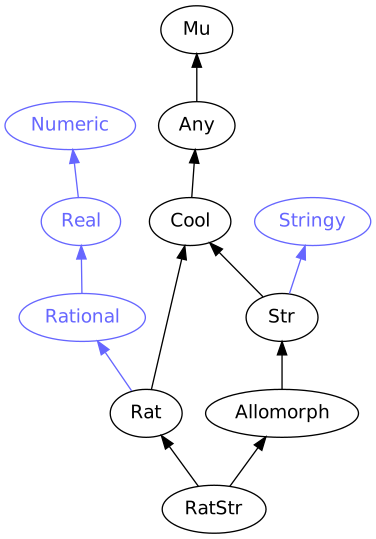
Full-size type graph image as SVGRat does role Rational, which provides the following methods:
method new(NuT:D $numerator, DenomT:D $denominator) returns Rational:D
Creates a new rational object from numerator and denominator.
method numerator(Rational:D:) returns NuT:D
Returns the numerator.
method denominator(Rational:D:) returns DenomT:D
Returns the denominator.
method nude(Rational:D:) returns Positional
Returns a list of the numerator and denominator.
method norm(Rational:D:) returns Rational:D
Returns a normalized Rational object, ie with positive denominator, and numerator and denominator coprime.
Rat inherits from class Any, which provides the following methods:
multi method ACCEPTS(Any:D: Mu $other)
Returns True if $other === self (ie it checks object identity).
Interprets the invocant as a list and creates an any-Junction from it.
Interprets the invocant as a list and creates an all-Junction from it.
Interprets the invocant as a list and creates an one-Junction from it.
Interprets the invocant as a list and creates an none-Junction from it.
Rat inherits from class Mu, which provides the following methods:
multi sub defined(Mu) returns Bool:D multi method defined() returns Bool:D
Returns False on the type object, and True otherwise.
multi sub Bool(Mu) returns Bool:D multi method Bool() returns Bool:D
Returns False on the type object, and True otherwise.
multi method Str() returns Str
Returns a string representation of the invocant, intended to be machine readable.
multi sub gist(Mu) returns Str multi method gist() returns Str
Returns a string representation of the invocant, optimized for fast recognition by humans.
The default gist method in Mu re-dispatches to the perl method, but many built-in classes override it to something more specific.
multi sub perl(Mu) returns Str multi method perl() returns Str
Returns a Perlish representation of the object (i.e., can usually be reparsed to regenerate the object).
method clone(*%twiddles)
Creates a shallow clone of the invocant. If named arguments are passed to it, their values are used in every place where an attribute name matches the name of a named argument.
multi method new(*%attrinit)
Default method for constructing (create + initialize) new objects of a class. This method expects only named arguments which are then used to initialize attributes with accessors of the same name.
Classes may provide their own new method to override this default.
method bless(Mu $candidate, *%attrinit) returns Mu:D
Lower-level object construction method than new.
If you pass a Whatever as a candidate, it creates a new object of the same type as the invocant, and then uses the named arguments to initialize attributes.
If you pass something other than a Whatever object as a candidate, it simply does the attribute initialization on the $candidate.
In both cases, the object with the attributes initialized is returned.
You can use this method when writing custom constructors:
class Point {
has $.x;
has $.y;
multi method new($x, $y) {
self.bless(:$x, :$y);
}
}
my $p = Point.new(-1, 1);
(Though each time you write a custom constructor, remember that it makes subclassing harder).
method CREATE() returns Mu:D
Allocates a new object of the same type as the invocant, without initializating any attributes.
multi method print() returns Bool:D
Prints value to $*OUT after stringification using .Str method without newline at end.
multi method say() returns Bool:D
Prints value to $*OUT after stringification using .gist method with newline at end.
multi method ACCEPTS(Mu:U: $other)
Performs a type check. Returns True if $other conforms to the invocant (which is always a type object or failure).
This is the method that is triggered on smart-matching against type objects, for example in if $var ~~ Int { ... }.
multi method WHICH() returns ObjAt:D
Returns an object of type ObjAt which uniquely identifies the object. Value types override this method which makes sure that two equivalent objects return the same return value from WHICH.