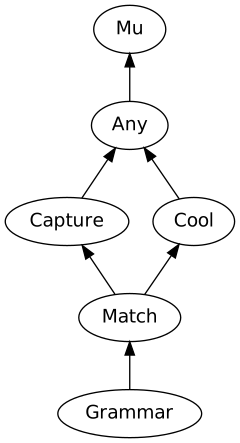
is Capture is Cool does NQPMatchRole
Match objects are the result of a successful regex match, including any zero-width match. They store a reference to the original string (.orig), positional and named captures, the positions of the start and end of the match in the original string, and a payload referred to as AST (abstract syntax tree), which can be used to build data structures from complex regexes and grammars.
The last match is also stored in the $¢ Match object, which is lexically scoped to the regex, that is, only available from within the regular expression, as shown here:
my ;'abc' ~~ /.$$/;say ; # OUTPUT: «「c」»
In this example we are running the code among curly braces when the match occurs, in this case the last letter in the string (actually, the last, indicated by the double $, character); $c gets the value of the cursor $¢, which contains the Match; when used with say, the Match is stringified by calling .Str on it. This $¢ offers a way of capturing the Match inside a regular expression; outside, you need to use $/
my ; 'camelia' ~~ / /;say ; # OUTPUT: «「m」»say $/; # OUTPUT: «「m」»
Note: This feature works only from Raku version 2018.02. It would have returned Nil with any previous version. Alternatively and prior to that version, you could use $/ which, inside the regex, has the same value:
'123' ~~ / (\d) \d+ /; # OUTPUT: «「1」「1」 0 => 「1」»
The main difference between $/ and $¢ is scope: the latter only has a value inside the regex:
'123' ~~ / (\d) \d+ /; # OUTPUT: «「1」 0 => 「1」「1」 0 => 「1」»say "¢ → ", $¢, "/ is $/"; ; # OUTPUT: «¢ → Nil/ is 123»
Submatches are also Match objects (or lists of Match objects, if the corresponding regex was quantified), so each match object can be seen as the root of a tree of match objects.
A Match object can also hold the result of a match in progress (while the grammar engine is running), in which case the pos method returns the current position. This view on Match objects is only visible if you call code from within a regex.
Note (deprecated): There is a synonym for this class, Cursor, defined as:
my constant Cursor = Match
Initially, it was used to keep track of initial position in regex matches. In current versions, it's an alias for Match.
Methods§
method pos§
Returns the current position as a string index into Match.target for a regex match in progress:
my = 'abcdef';~~ /b. ../; # OUTPUT: «3»
You should not use this method on a finished Match, as the output can be implementation specific or is, in any case, unspecified.
method target§
method target()
Returns a string representation of the object against which the regex matches. This is the value that the regex engine works with internally.
my = "þor" ~~ /o/;say .target # OUTPUT: «þor»
method chars§
method chars()
Returns the numbers of characters in the matched string or 0 if there's been no match.
Returns the same as .Str.chars.
method clone§
method clone()
Clones the Match object.
method orig§
method orig()
Returns the original input to the regex engine, which is usually a string, but doesn't need to be (could be anything that can be coerced to a string):
42 ~~ /.+/;say $/.orig; # OUTPUT: «42»say $/.orig.^name; # OUTPUT: «Int»
See #method target for a close equivalent that always returns a string.
method from§
method from()
Returns the index of the starting position of the match.
method to§
method to()
Returns the index of the position next to the end of the match. It will return the match position if the end of the match is negative, and Nil if there has been no match.
method made§
method made()
Returns the payload that was set with make.
routine make§
method make(Match: Mu )sub make(Mu )
Sets the .ast attribute, which will be retrieved using .made.
$/.make("your payload here");
That is, it stores an arbitrary payload into the Match object that can later be retrieved via .made method. Since the sub form operates, by default, on $/, that example is equivalent to:
make("your payload here");
This is typically used in a grammar's actions class methods, where a piece of data is stored by one method and then later retrieved by another. It's up to you what data you store. It could be a tree node, result of a calculation, a type object, or a list of values.
The sub form operates on the current Match $/, which can be a convenient shortcut:
method my-action ($/)
method actions§
method actions(Match: --> Mu)
Returns the actions object (if any was set; else Mu) that the grammar used from which this Match object was created.
method ast§
Alias for #method made.
method Bool§
method Bool(Capture: --> Bool)
Returns True on successful and False on unsuccessful matches. Please note that any zero-width match can also be successful.
say 'abc' ~~ /^/; # OUTPUT: «「」»say $/.from, ' ', $/.to, ' ', ?$/; # OUTPUT: «0 0 True»
method Str§
method Str(Match: --> Str)
Returns the matched text.
"abc123def" ~~ /\d+/;say $/.Str; # OUTPUT: «123»
method Int§
method Int(Match: --> Int)
Tries to convert stringified result of the matched text into Int.
say ('12345' ~~ /234/).Int; # OUTPUT: «234»say ('12345' ~~ /234/).Int.^name; # OUTPUT: «Int»# the next line produces a warning about using Nil (result of a no match) in numeric contextsay ('one-two' ~~ /234/).Int; # OUTPUT: «0» # because Nil.Int returns 0
method caps§
Returns a list of pairs, with the index or submatch name as key and the submatches as values. The list is ordered by starting position of the submatches.
method chunks§
Returns a list of pairs, with the index or submatch name as key and the submatches as values. The list is ordered by starting position of the submatches.
Those parts of the string that were not matched by submatches are interleaved with the other pairs, with the string ~ as key.
method list§
Returns a list of positional submatches.
method hash§
Returns a hash of named submatches.
method prematch§
method prematch(Match: --> Str)
Returns the part of the original string leading up to the match.
'abcdefg' ~~ /cd/;say $/.prematch; # OUTPUT: «ab»# will return a list of three match objects"abc123def" ~~ m:g/\d/;say $/.[1].prematch; # OUTPUT: «abc1»
method postmatch§
method postmatch(Match: --> Str)
Returns the part of the original string following the match.
'abcdefg' ~~ /cd/;say $/.postmatch; # OUTPUT: «efg»# will return a list of three match objects"abc123def" ~~ m:g/\d/;say $/.[1].postmatch; # OUTPUT: «3def»
method replace-with§
multi method replace-with(Match: Str() --> Str)
Returns the invocant string where the Match object is replaced by $replacement.
my Str = "Some foo";my Match = .match(/foo/);my = .replace-with("string"); # «Some string»
infix eqv§
multi sub infix:<eqv>(Match \a, Match \b)
Returns True if the attributes pos, from and orig for a and b are equal, and if made, Capture::list and Capture::hash are either the same or both undefined.
Typegraph§
Match