class Backtrace is List { ... }
A backtrace shows the dynamic call stack, usually leading up to a point where an exception was thrown.
It is a List of Backtrace::Frame objects. Its default stringification excludes backtrace frames that are deemed unnecessary or confusing, for example routines like &die are hidden by default.
proto method new(*@, *%) {*}
multi method new()
Creates a new backtrace, using its calling location as the origin of the backtrace.
multi method Str(Backtrace:D:) returns Str:D:
Returns a concise string representation of the backtrace, omitting routines marked as is hidden_from_backtrace, and at the discretion of the implementor, also some routines from the setting.
multi method full(Backtrace:D:) returns Str:D:
Returns a full string representation of the backtrace, including hidden frames, compiler-specific frames and those from the setting.
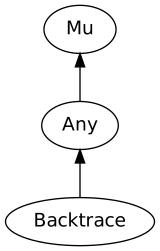
Full-size type graph image as SVGBacktrace inherits from class List, which provides the following methods:
multi sub elems($list) returns Int:D multi method elems(List:D:) returns Int:D
Returns the number of elements in the list.
multi sub end($list) returns Int:D multi method end(List:D:) returns Int:D
Returns the index of the last element.
multi sub keys($list) returns List:D multi method keys(List:D:) returns List:D
Returns a list of indexes into the list (i.e., 0..(@list.elems-1)).
multi sub values($list) returns List:D multi method values(List:D:) returns List:D
Returns a copy of the list.
multi sub kv($list) returns List:D multi method kv(List:D:) returns List:D
Returns an interleaved list of indexes and values. For example
<a b c>.kv
Returns
0, 'a', 1, 'b', 2, 'c'
multi sub pairs($list) returns List:D multi method pairs(List:D:) returns List:D
Returns a list of pairs, with the indexes as keys and the list values as values.
<a b c>.pairs # 0 => 'a', 1 => 'b', 2 => 'c'
multi sub join($separator, *@list) returns Str:D multi method join(List:D: $separator) returns Str:D
Treats the elements of the list as strings, interleaves them with $separator and concatenates everything into a single string.
Example:
join ', ', <a b c>; # 'a, b, c'
multi sub map(&code, *@elems) returns List:D multi method map(List:D: &code) returns List:D
Invokes &code for each element and gathers the return values in another list and returns it. This happens lazily, ie &code is only invoked when the return values are accessed.
Examples:
> ('hello', 1, 22/7, 42, 'world').map: { .WHAT.perl }
Str Int Rat Int Str
> map *.Str.chars, 'hello', 1, 22/7, 42, 'world'
5 1 8 2 5
multi sub grep(Mu $matcher, *@elems) returns List:D multi method grep(List:D: Mu $matcher) returns List:D
Returns a lazy list of elements against which $matcher smart-matches. The elements are returned in the order in which they appear in the original list.
Examples:
> ('hello', 1, 22/7, 42, 'world').grep: Int
1 42
> grep { .Str.chars > 3 }, 'hello', 1, 22/7, 42, 'world'
hello 3.142857 world
multi sub first(Mu $matcher, *@elems) multi method first(List:D: Mu $matcher)
Returns the first item of the list which smart-matches against $matcher, fails when no values match.
Examples:
say (1, 22/7, 42).first: * > 5; # 42
say $f = ('hello', 1, 22/7, 42, 'world').first: Complex;
say $f.perl; # Failure.new(exception => X::AdHoc.new(payload => "No values matched"))
multi sub classify(&mapper, *@values) returns Hash:D multi method classify(List:D: &mapper) returns Hash:D
Transforms a list of values into a hash representing the classification of those values according to a mapper; each hash key represents the classification for one or more of the incoming list values, and the corresponding hash value contains an array of those list values classified by the mapper into the category of the associated key.
Example:
say classify { $_ %% 2 ?? 'even' !! 'odd' }, (1, 7, 6, 3, 2);
# ("odd" => [1, 7, 3], "even" => [6, 2]).hash;;
say ('hello', 1, 22/7, 42, 'world').classify: { .Str.chars }
# ("5" => ["hello", "world"], "1" => [1], "8" => [22/7], "2" => [42]).hash
multi method Bool(List:D:) returns Bool:D
Returns True if the list has at least one element, and False for the empty list.
multi method Str(List:D:) returns Str:D
Stringifies the elements of the list and joins them with spaces (same as .join(' ')).
multi method Int(List:D:) return Int:D
Returns the number of elements in the list (same as .elems).
multi sub pick($count, *@list) returns List:D multi method pick(List:D: $count = 1)
Returns $count elements chosen at random and without repetition from the invocant. If * is passed as $count, or $count is greater than or equal to the size of the list, then all elements from the invocant list are returned in a random sequence.
Examples:
say <a b c d e>.pick; # b b say <a b c d e>.pick: 3; # c a e say <a b c d e>.pick: *; # e d a b c
multi sub roll($count, *@list) returns List:D multi method roll(List:D: $count = 1)
Returns a lazy list of $count elements, each randomly selected from the list. Each random choice is made indepently, like a separate die roll where each die face is a list element.
If * is passed to $count, returns a lazy, infinite list of randomly chosen elements from the original list.
Examples:
say <a b c d e>.roll; # b b say <a b c d e>.roll: 3; # c c e say roll 8, <a b c d e>; # b a e d a e b c
my $random_digits := (^10).roll(*); say $random_digits[^15]; # 3 8 7 6 0 1 3 2 0 8 8 5 8 0 5
multi method eager(List:D:) returns List:D
Evaluates all elements in the list eagerly, and returns the invocant. If a List signals that it is "known infinite", eager evaluation may stop at the point where the infinity is detected.
multi sub reverse(*@list ) returns List:D multi method reverse(List:D:) returns List:D
Returns a list with the same elements in reverse order.
Note that reverse always refers to reversing elements of a list; to reverse the characters in a string, use flip.
Examples:
say <hello world!>.reverse # world! hello say reverse ^10 # 9 8 7 6 5 4 3 2 1 0
multi sub rotate(@list, Int:D $n = 1) returns List:D multi method rotate(List:D: Int:D $n = 1) returns List:D
Returns the list rotated by $n elements.
Examples:
<a b c d e>.rotate(2); # <c d e a b> <a b c d e>.rotate(-1); # <e a b c d>
multi sub sort(*@elems) returns List:D multi sub sort(&by, *@elems) returns List:D multi method sort(List:D:) returns List:D multi method sort(List:D:, &by) returns List:D
Sorts the list, smallest element first. By default < infix:<cmp >> is used for comparing list elements.
If &by is provided, and it accepts two arguments, it is invoked for pairs of list elements, and should return Order::Increase, Order::Same or Order::Decrease.
If &by accepts only one argument, the list elements are sorted according to < by($a) cmp by($b) >. The return values of &by are cached, so that &by is only called once per list element.
Examples:
say (3, -4, 7, -1, 2, 0).sort; # -4 -1 0 2 3 7
say (3, -4, 7, -1, 2, 0).sort: *.abs; # 0 -1 2 3 -4 7
say (3, -4, 7, -1, 2, 0).sort: { $^b leg $^a }; # 7 3 2 0 -4 -1
multi sub reduce(&with, *@elems) multi method reduce(List:D: &with)
Applies &with to the first and the second value of the list, then to the result of that calculation and the third value and so on. Returns a single item generated that way.
Note that reduce is an implicit loop, and thus responds to next, last and redo statements.
Example:
say (1, 2, 3).reduce: * - *; # -4
multi sub splice(@list, $start, $elems?, *@replacement) returns List:D multi method splice(List:D: $start, $elems?, *@replacement) returns List:D
Deletes $elems elements starting from index $start from the list, returns them and replaces them by @replacement. If $elems is omitted, all the elements starting from index $start are deleted.
Example:
my @foo = <a b c d e f g>; say @foo.splice(2, 3, <M N O P>); # c d e say @foo; # a b M N O P f g
multi sub pop(List:D ) multi method pop(List:D:)
Removes and returns the last item from the list, fails for an empty list.
Example:
> my @foo = <a b>; a b > @foo.pop; b > pop @foo a > pop @foo Element popped from empty list
multi sub push(List:D, *@values) returns List:D multi method push(List:D: *@values) returns List:D
Adds the @values to the end of the list, and returns the modified list. Fails for infinite lists.
Example:
my @foo = <a b c>; @foo.push: 1, 3 ... 11; say @foo; # a b c 1 3 5 7 9 11
multi sub shift(List:D ) multi method shift(List:D:)
Removes and returns the first item from the list. Fails for an empty list.
Example:
my @foo = <a b>; say @foo.shift; # a say @foo.shift; # b say @foo.shift; # Element shifted from empty list
multi sub unshift(List:D, *@values) returns List:D multi method unshift(List:D: *@values) returns List:D
Adds the @values to the start of the list, and returns the modified list. Fails if @values is infinite.
Example:
my @foo = <a b c>; @foo.unshift: 1, 3 ... 11; say @foo; # 1 3 5 7 9 11 a b c
Backtrace inherits from class List, which does role Positional, which provides the following methods:
method of()
Returns the type constraint for elements of the positional container. Defaults to Mu.
Backtrace inherits from class Any, which provides the following methods:
multi method ACCEPTS(Any:D: Mu $other)
Returns True if $other === self (ie it checks object identity).
Interprets the invocant as a list and creates an any-Junction from it.
Interprets the invocant as a list and creates an all-Junction from it.
Interprets the invocant as a list and creates an one-Junction from it.
Interprets the invocant as a list and creates an none-Junction from it.
Backtrace inherits from class Mu, which provides the following methods:
multi sub defined(Mu) returns Bool:D multi method defined() returns Bool:D
Returns False on the type object, and True otherwise.
multi sub Bool(Mu) returns Bool:D multi method Bool() returns Bool:D
Returns False on the type object, and True otherwise.
multi method Str() returns Str
Returns a string representation of the invocant, intended to be machine readable.
multi sub gist(Mu) returns Str multi method gist() returns Str
Returns a string representation of the invocant, optimized for fast recognition by humans.
The default gist method in Mu re-dispatches to the perl method, but many built-in classes override it to something more specific.
multi sub perl(Mu) returns Str multi method perl() returns Str
Returns a Perlish representation of the object (i.e., can usually be reparsed to regenerate the object).
method clone(*%twiddles)
Creates a shallow clone of the invocant. If named arguments are passed to it, their values are used in every place where an attribute name matches the name of a named argument.
multi method new(*%attrinit)
Default method for constructing (create + initialize) new objects of a class. This method expects only named arguments which are then used to initialize attributes with accessors of the same name.
Classes may provide their own new method to override this default.
method bless(Mu $candidate, *%attrinit) returns Mu:D
Lower-level object construction method than new.
If you pass a Whatever as a candidate, it creates a new object of the same type as the invocant, and then uses the named arguments to initialize attributes.
If you pass something other than a Whatever object as a candidate, it simply does the attribute initialization on the $candidate.
In both cases, the object with the attributes initialized is returned.
You can use this method when writing custom constructors:
class Point {
has $.x;
has $.y;
multi method new($x, $y) {
self.bless(:$x, :$y);
}
}
my $p = Point.new(-1, 1);
(Though each time you write a custom constructor, remember that it makes subclassing harder).
method CREATE() returns Mu:D
Allocates a new object of the same type as the invocant, without initializating any attributes.
multi method print() returns Bool:D
Prints value to $*OUT after stringification using .Str method without newline at end.
multi method say() returns Bool:D
Prints value to $*OUT after stringification using .gist method with newline at end.
multi method ACCEPTS(Mu:U: $other)
Performs a type check. Returns True if $other conforms to the invocant (which is always a type object or failure).
This is the method that is triggered on smart-matching against type objects, for example in if $var ~~ Int { ... }.
multi method WHICH() returns ObjAt:D
Returns an object of type ObjAt which uniquely identifies the object. Value types override this method which makes sure that two equivalent objects return the same return value from WHICH.